June 22nd, 2010 by admin

We are getting ready to launch something that will revolutionize the fishing industry! Take your game to the next level! Register today and your name will be entered in our weekly drawing for some free stuff!
Register with us today to win!
August 20th, 2010 by admin

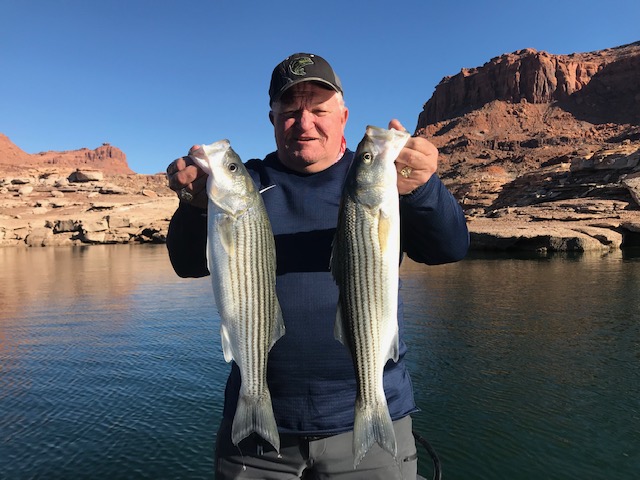
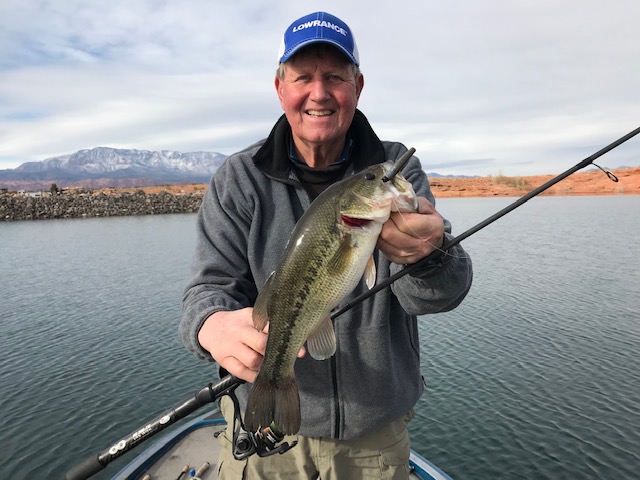
These two fell for a jig on Day one
Tournament anglers, especially those who don’t fish full time are constantly forced to make tough decisions as to when and where to fish the next series of events. Last year, I chose to sit the tournament season out and I ran for mayor of Provo, Utah, my adopted hometown. Although I still fished a little, especially after I lost a close race in the primaries, I spent less than a week on the water. Late in the fall, I put together a plan to get back into tournament form and decided to again fish a few tournaments in 2010.
By January, I had recommitted to fish at least the Utah individual tournaments for both the FLW and B.A.S.S. federations. Since I’ve been a “professional angler” since 2001, I know all too well how difficult it is to pick up your tools and immediately be considered competitive in this sport. Not only were my rods, reels, and tackle in disarray, I wasn’t in tournament shape. Although my weight wasn’t a problem nor was my activity level (I play basketball three days a week for two hours a day), when I’m fishing bass tournaments the prefishing days are 14 hours long, and tournament days are very intense, and I NEVER use a seat on my boat except to drive. My greatest fear was not being able to remain focused as I shook off the rust and learned once again how to fish tournaments.
The first series of events were on Lake Powell in April. I took two trips to the lake, one in March and the other just before the off-limits period began, to become reacquainted with one of my favorite fisheries. Believe it or not, the toughest part of the prefishing period was finding fish. That was literally a first at Lake Powell. The water level was 20 feet higher than the previous year and I couldn’t pattern fish activity. Oh, I caught a few fish here and there, but I struggled to put a five-fish limit in the boat. Suddenly, Lake Powell began to grow. None of my go-to spots were producing and that meant I had to begin to cut the reservoir into pieces looking for “new” water, a daunting task when you consider that Lake Powell has close to 2000 miles of shoreline.
I decided after a couple of days in which I did find some pretty good water, that those areas weren’t special enough to convince me to run almost 40 miles north of our launch area at Bullfrog to spend my tournament days. So, when it came time for our one-day prefish in preparation for two one-day FLW/TBF tournaments near the middle of April, I stayed close to the ramp and looked for fish within a few miles.
I found plenty of fish close by but I doubted I had the stamina, patience, and skill set necessary to finish in the top ten of a very talented group of anglers. My hook-setting abilities still suffered, and my reflexes weren’t as sharp as they should have been. The stars would need to align for me to be competitive.
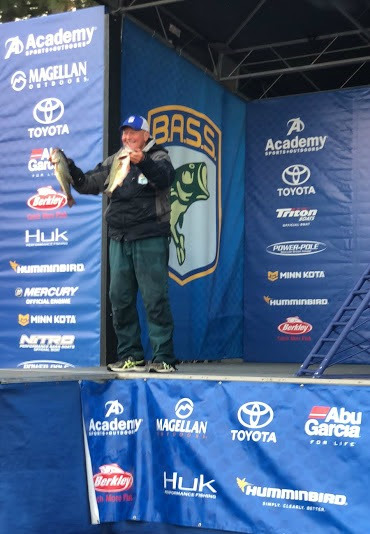
On day one of the event, I fished within a few miles of the launch ramp in Bullfrog and Hall’s bay, and found some very nice fish that were in the pre-spawn mode. I was able to catch 9 fish, culling four for a limit of largemouth bass that weighed 16.72 pounds. That was good enough for second place by a couple of ounces. Remember, I only had to finish in the top ten to be in the driver’s seat for making the state team. So, day one was a huge success and gave me some confidence going into day two.
On day two, after a mishap with the net at the boat on a very large fish, I still was able to finish 7th with 13.75 pounds of bass. Although I was drained beyond belief after each day’s event, I thanks the Lord for granting me a nice come back from my time off. However, the quest to get back into true tournament form was not over … not by a long shot. In the next post, I’ll continue describing the process of coming back after a long break from the rigors of tournament angling.
July 19th, 2010 by admin
by Don Allphin

So Many Things To Get Excited About!
Many people ask me why I try to attend the ICAST show each year. Since I sold Bass West Magazine almost eight years ago, folks wonder what would keep me in the loop? First and foremost, nothing in my overall personal or business game plan changed when I sold Bass West. I still write, I still consult for both fishing and manufacturing companies, and I handle a number of smaller projects on a local and regional level. And, of course, I still fish … a lot.
ICAST is a great place to get charged up over the future of our sport and industry. It is impossible witness the innovations, the new designs or even the new attitudes that dominate the floor of the convention, and not get excited. It is refreshing to see companies making great strides towards their goals despite the economy, despite the banking challenges, and despite the environmental pressures on fishing in general. This is why I am so bullish on the United States of America. We don’t just slip quietly into the night. Regardless of the challenges, we reach down deep, pull ourselves up by the boot straps and soldier on. It’s in our genes, we can’t help it. Thank Goodness!
I helped design a new lure this year, a Giant Gitzit in the 8- and 10- inch size for Canyon Plastics. This ICAST show was the first opportunity to show off the new bait. In the tank, the bait performed extremely well, and since we’ve been testing it in the field on huge lake trout for a few months now, we know the bait works and works well. I think Jay Pennington was happy with his show sales for the new bait.
Allow me to make a couple of observations about this year’s ICAST event. First, there are still a lot of new baits, tackle, and equipment coming to market. Many companies from around the world are improving baits, inventing new ones, and are still trying to penetrate the U.S. market. To me, That is like catching a 4-pound smallmouth, a 2-pounder, a few 1-pound fish, and a few 8-inch fish on the same trip. This shows is a healthy environment. The established companies are surviving and doing well; the start ups are getting funded (to an extent), and we the consumers will be the ultimate beneficiaries, as more and better products show up on retail shelves.
Next, younger and older companies alike went to Las Vegas looking for answers from those to whom they sell. Questions were everywhere about globalization, going green, and producing short and long-term business models that work. Many companies including Kistler Rods. for example, are moving their production back to the U.S. after years in China. This could be a trend in the near future. I am thrilled to see this come to fruition because we need jobs for residents of the U.S. and Trey Kistler is realizing that loyalty CAN be built on-shore quicker and more efficiently than any off-shore business. the cool thing too is that when companies actually ask their customers what they think, and then build a product as a reflection of those thoughts and comments, half the selling problem is solved. Customers know what they want, but at times have a hard time expressing those desires to companies so ensconced in their business plans that they don’t seem to notice their market share is dropping until it’s too late. ICAST is a great event to prove my point. Many established companies spent their time at ICAST asking questions. They had their crystal balls out and were trying to see through the fog of the current market for answers. That is very healthy as well.
Opportunities in the fishing industry abound. I see a future including small companies who will begin to rival larger ones. I see dealer networks expanding in ways only imagined right now. And, I see more people spending serious time on the water. Opportunities are out there literally everywhere and I’m thrilled to still be a significant part of the equation.
May 20th, 2010 by admin

Six-pound cruiser fooled by a Senko
In Part One of this article, I wrote about how to handle catching largemouth bass while on or near their beds. In this post, let’s answer the question, “How do you get finicky largemouth to bite.” First of all, we are still talking about spawn and postspawn fish. One of the most difficult times to catch largemouth is when they’ve already been hooked. But, there is a relatively simple way to entice that fish to strike again.
As i’ve written before, bass do have personalities. They behave in unique ways. If a bass has already been hooked and either broke off or came unpinned and eventually takes its position back on the bed (nest), you must assess the personality first and then devise a plan to catch the fish. Pitch a large jig back on the nest. Most of the time, the bass will ignore the offering. Perhaps it will watch the lure but won’t make a move towards it. Then, after giving it a chance to settle down re-pitch the jig to the other side of the fish so the line will rub across its back. This will either bother the bass or maybe not. If it bothers the fish it will either leave the nest or turn to see what has just touched it. There will be times that the bass will strike whatever it sees after turning. But more times than not, it will seemingly remember the last encounter with a hook and will not immediately strike.
If the bass refuses to bite repeat the process. Pitch the jig so that the line rubs across the fish’s back. Then, watch for the response. If the bass stays on the bed and turns toward the jig, you WILL be able to catch that fish. if at that point, it leaves the bed, you must go back to square one and start the process all over again when and if it returns. Don’t waste too much time with that fish.
If the fish turns and faces the jig, twitch it ever so slightly with the thought that you are challenging the bass to do something about it. If the bass simply continues to watch the lure, repeat the process one more time. If the bass turns again, and just watches the lure, remove the lure from the bed and replace it with a much smaller offering. Try a bright colored tube, or grub perhaps, or even a small Senko or other stick bait (three inches or less). As before, pitch the lure to the opposite side of the bass so the line is pulled across its back. When the bass turns on the bait it will see the smaller offering and will generally strike.
Remember, move from large to small as the process of enticing a strike continues. It’s okay to have several rods on the deck with each rod rigged with larger-to-smaller versions of your lures.
Catching Cruising Bass
Catching cruising bass can be tough for everyone, and don’t believe there is a surefire way to ALWAYS catch them. However, cruising bass can be caught and the following methods are as good as they come when targeting spawn and postspawn fish. The first method is to cast a weightless Senko or other stick bait way ahead of the cruising bass, allowing the bait to slowly drift to the bottom. In this way, as the bass leaves the area of the boat and heads toward the Senko it feel secure, and there in front of it is a slow-falling morsel just waiting to be eaten. Make long casts and be very patient while the lure sinks.
Next, try casting a split-shot rig with a weightless tube rigged under a couple of tiny split shots with a leader around 24 inches in length (a little longer in grass and a little shorter in rocks). Try again to make long casts and allow the lure to slowly sink to the bottom. Remember to keep the boat away from the lure. At times with both the Senko and the split-shot rig, after the cast back off the area by releasing line so that the presentation still falls vertically but the boat and you are farther away.
The key here is to remove as many of the “fear factors” that a bass may have while still presenting something to eat. Stay back, make long casts and be extra patient as the lure sinks.
Post spawn largemouth will begin to eat within a few days of laying eggs. They will rest first and eat later, however if a lure is properly presented with no visible obstacles for the bass to negotiate, they will bite. Good luck and good fishing!
May 10th, 2010 by admin

The worst thing to do is let your nesting bass jump!
Bass are wonderful creatures. They have simple brains but their instincts are complex and their behavior can be difficult to read. Let’s explore the art of sight fishing for largemouth bass while on or near their nests, and in the process learn how to quickly determine if a bass is ready to be caught, is not worth waiting on to become ready, and finally, to give you a plan of attack the next time you come across a nesting bass.
No question about it, bass have personalities. Now don’t think for a moment I believe they have feelings, they make conscientious decisions, and have photographic recall. But, they do behave in specific ways that vary from bass to bass.
Holding on beds
The only disclaimer here is that I am assuming you are fishing in relatively clear water so you can see the fish you are trying to catch. When you come across a bed (which looks like an area, usually two feet by two feet in size with a few pieces of small rock or gravel that appears as if someone or something has tried to sweep it clean, located next to it is a piece of wood or grass structure) and a largemouth bass is on or near the bed, gently move your boat away from the area. Not far enough to lose visibility but far enough that the fish continues in its normal routine.
Then, take a pitching stick with a jig tied on and pitch it to the nest. Be sure the bait comes to rest exactly on top of the spot the bass was sitting if it can be determined it was actually on its nest as you first passed by. Just leave the jig there and observe the fish’s behavior. Did it scurry away? It it ignore the bait? Did it leave the entire area, or did it simply move off the nest and then return to stare at your presentation?
The answers to these questions are crucial to understanding this particular bass’s personality and his readiness to be locked on to the nest. If the bass were to scurry away but then returns within a few seconds, that’s good news — he may be catchable. If he leaves the next entirely, and doesn’t return within a minute or five, a couple of things might be at work. First, this bed might not even be his/her bed. The bass may be trying to take the bed of another fish that has either been caught or has momentarily left the nest and is not currently in the vicinity. Or, the bass could be wanting to nest and is willing care for one but is still not ready to occupy the nest until it completes its mating ritual. Either way, unless the bass comes back near the nest within a few minutes, this might be the bass to leave behind to look for greener pastures. The most interesting frustrating bass behavior in this scenario is the bass that returns to the nest and simply stares at the bait. Or better yet, the bass might ignore the bait. That’s when catching the bass become exciting.
As an aside, when I said to throw your jig onto the nest, a certain percentage of bass will immediately inhale the bait and all this writing is not needed. I’ve had many a bass simply turn, identify the intruder and attack. Those kind of bass are the ones you pray for on tournament day, when you’re fishing against the clock.
Now, back to our bass that is staring at the bait. I always keep four or five rods on my deck when fishing a specific bed, each set up with a different bait. Sometimes I vary the color, but most of the time I vary the size of my offering. I start large and them move smaller as time goes on. If the bass refuses to do anything with the jig, I pick up a Senko. The Senko color is not as important as the size(generally 4 to 5 inches) and the way it is rigged. Wacky rigging (a hook brought through the center of the bait with the hook exposed) is by far my favorite presentation. Then, I throw the Senko on the nest in the same manner as the jig. The slow, lumbering drop of the Senko onto the nest at times gets the same response as a jig, a violent attack from the bass.
If that doesn’t work, I move to a Gitzit. Canyon Plastic is a great producer of tubes of all shapes and sizes. I like the 3 1/2 inch tubes in Green Pumpkin the best. If that doesn’t work I move to a dropshot “tini-tube” by Strike King Lures. The dropshot leader needs to allow the bait to stay between four and six inches above the next, right in the fish’s face.
If none of these techniques work I like to go back to my jig and attempt to tough the fish on its nose with the jig. This is to make the fish uncomfortable in his/her current position. If the bass gets frustrated and quickly moves away and then turns on the bait — hold on because he’s about to strike.
Now, let’s talk about the bass that moves off the nest and doesn’t really come back to the nest but stays close. Most bass make a large loop or circle around the nesting area. Sometimes they will move under the boat or just make a large 10 yard circle, always returning to the nest after the “swim about”. Observe to see if each time the bass leaves the nest the circle gets smaller. When this happens I know it’s just a matter of time and patience before that bass is in my live well.
This is only part one of a two-part story. I’ll write about how to manage a very finicky bass and how to catch a bass that has already struck your bait only to come off and is still in the area. Also, I will cover how to catch “cruising fish” that aren’t on any bed, both in the spawn and postspawn realm. So good fishing and we’ll see you next time.
April 30th, 2010 by admin
Those who know me are aware that I have argued against the need to “save” the June sucker from the very beginning. I still believe there was an intended or unintended fraud perpetrated upon us by those who “typed” this “hybrid” fish, and I’ve seen no science to disprove this statement. That being said, good old NEPA ( The National Environmental Policy Act) does seem to rule here and so if we want any more water in our transport systems from eastern Utah to Utah lake, we’d better face the music and realize we must play along with this unfortunate game.
Big Changes in the Provo River
The area proposed for the delta will completely alter and change the way the river enters the lake. This affects not only people who make their livings on or near the river, but it affects those who travel up and down the trails in the area, ride bikes, roller blade, and run. I strongly oppose any changes in the path the river takes.
If a delta is needed (which is still unclear in my mind since there is no data available from the Hobble Creek delta project), then I believe the water for such a project should be pumped from the current river, thus maintaining the flow we now have (with added CUP water) below the pumping area, yet allowing the Recovery Program to operate in their “new area”. Though we may need to “dance” with the June sucker, there is no need to pour salt and vinegar in the wound.
Fisher Ditch
There is a ditch in the general area of the proposed delta – the “Fisher” ditch that meanders through the fields to the north and west of the proposed area and ends in the lake. Why couldn’t that “established” ditch be expanded and used for your purposes? It is my opinion that sucker most likely already use that ditch at times in the year, and it would seem to me that you would have a greater opportunity to perhaps “train” sucker to use a 100-plus-year-old ditch rather than starting new again.
There Might Be A Better Way
I have more to say about the overall project. I would like to suggest a complete change in approach to saving and recovering the June sucker. As I see it, more than 80 per cent of my readers are opposed to ANY action to save the sucker. However, these same readers want better access to Utah Lake in general and Provo Bay to be specific. People want channels for fishing, boating, and recreating. They want parts of the lake dredged, deepened, and in short, cared for. So, why don’t you come up with a plan that includes spending money on improving the lake and as a spillover benefit, you get everything you need to help the June sucker? To me, this wouldn’t be a tough call. People don’t mind that you “save” sucker – what they mind is the arrogance with which the project is administered, and lip service that is paid to those who sincerely question the efforts of the agencies involved. We are in crisis mode with government spending and it irks people to see our hard-earned tax dollars being spent on something that even after 20 years of effort we don’t really see numbers improving, which has to be a PR nightmare. Five or so years ago, a few Gizzard shad escaped from a reservoir upstream from the San Juan River in Lake Powell. And, with NO help from the government, the shad have expanded to all areas in the lake. So, why hasn’t the June sucker done the same thing? People are asking that question of me almost weekly. If “saving” the June sucker were “part” of the Utah Lake Improvement District (or whatever title you wanted for it), I believe you would get immediate buy in and people would get off your backs and allow you to complete your work.
Finally, although this is near treason to suggest such a thing, if predation is one of the suckers’ biggest hurdles in its recovery, why wouldn’t having more forage fish in the lake help the project. Follow me on this: If the carp removal were to be successful, why wouldn’t a fish like the gizzard shad for example serve to protect the sucker as they expand to take the place of the carp. I know there will be those who would say that they would compete with the sucker for food, but simply consider what having another excellent forage species in the lake would mean as sucker develop. Remember, shad are not grass eaters and would not tear up the bottom of the lake. The sucker would become less of a target and could grow in relative peace. Just a thought.
April 27th, 2010 by admin
by Don Allphin

The primary spawning period for large and smallmouth bass on Lake Powell begins during either the new moon or full moon phase when the morning surface temperature hits 57 degrees. In 2010, the new moon phase was dominant in the Bullfrog, Halls, Wahweep, and the San Juan Arm of the Lake. Largemouth bass moved onto their nests in mid April. The next wave of spawning bass will take to their beds this week, as long as the weather continues to warm. Between the new and full moon phases, a cold front moved through and water temperatures dropped at least 6 degrees in the open bays around Bullfrog. The bass moved back off the beds into their staging areas to await warmer water. Sunday, April 25th marked the first day when morning temperatures again hit 57 degrees, and the bass moved back on their nests in great numbers.
Lake Powell is as healthy right now as I’ve ever seen. All fish species of fish seem to be flourishing — even the forage fish. Gizzard shad cover the bottom of most coves and bays, and thread fin shad are recovering nicely. Stripers are fat and sassy, walleyes, crappies, blue gills, and both species of bass are growing like weeds.
In the Utah TBF (The Bass Federation) spring qualifying tournament held April 17th and 18th, it took 16.62 pounds to win an individual event weighing the five largest large or smallmouth bass in an 8 hour period. I took second place with 16.42 pounds and really could have weighed a couple of more pounds if I had been able to keep one more fish on the hook. In the recent past, 12 pounds of fish would win most individual tournaments on the lake. It is a testament to the health of Lake Powell that tournament weights are increasing rapidly.
The best baits to use to target pre-spawn, spawn, and post-spawn bass really depend on how you choose to fish. If you plan on sight fishing (actually finding the beds and watching the fish take the bait) tubes, grubs, small swimbaits, Senkos, and soft jerkbaits work very well. Remember that the brighter the colors the better you the angler can see the bait on the nest. I’ll write about the specific ways to entice a strike from spawning bass on a later post. If you choose to target pre-spawn fish, crankbaits, spinnerbaits, jigs, and swimbaits seem to work best Vary your lures, retrieves and timing to settle in on the most effective method.
Suffice it to say that Lake Powell is truly on fire, and will stay that way as long as the water levels continue to rise and the forage continues to be abundant. It’s been a long time coming, but America’s Wonderland is back, and back in a big way!
April 21st, 2010 by admin
by Don Allphin

My name is Don Allphin and I am an entrepreneur. I am a writer, a real estate investor, a business consultant, photographer, and last but not least, a professional bass angler. Early last Summer I took 10 months off, got involved in local politics and ran for Mayor of my adopted hometown, Provo, Utah. Though I didn’t win the election (18 percent of the vote in the primaries when I needed 23 percent to move on) I made sure people understood who I am, and what I stand for. It is about this subject I’m blogging today.
I believe in the Constitution of the United States of America. I believe in unfettered free speech as contained in the First Amendment. And, today was a great day for First Amendment Rights. The Professional Outdoor Media Association (POMA), of which I am a charter member, has been following, and participating in the Robert Stevens case. A Virgina man who was convicted of the “crime” of being involved in journalist endeavors with regards to animals in their natural environment.
The Supreme Court upheld the 5th Circuit Court of Appeals decision that voided Stevens’ conviction. “POMA is grateful to the cour for this important decision,” said Laurie Lee Dovey, POMA executive director. “The First Amendment rights of traditional outdoor sports journalists, those who cover legal hunting and fishing and promote the enjoyment of these American heritage sports are protected. The impact of the decision on POMA members, all journalists, and the outdoor industry can not be overstated.”
We now live in a society that is way out of touch with the “real” United States, urban dwellers who rarely see beyond the cityscape. Many do not appreciate the wide open spaces, the wild parts of our country, the swamps of Louisiana, the Rocky Mountains, or the deserts of the Southwest. But this is my home, and I want the world to know that I do get it. I understand we need to be good stewards, to the environment, to the earth, and to each other. But at the same time, I don’t “get” the arrogance of those who actually believe “they” can “save” our planet. We speak of man-made global warming, but say nothing of the Nature-made ash plume that has shut down Europe for a week. Where is their arrogance now? How can “they” save us from Nature? Dead Silence.
I love the outdoors, and you will see as you continue to read future blogs that I have opinions and am not afraid to share them. Please come along for the ride and feel free to share your thoughts on this or any of the topics that seep out of my very curious and overactive brain.
April 4th, 2010 by admin
by Don Allphin

For me, springtime on Utah Lake means quick, short fishing trips using a small boat ready to go at a moment’s notice, and sharing each adventure with a friend who is just as passionate about catching largemouth bass as I. Bob Johnson is a neighbor of mine who I met for the first time on the roof of a houseboat parked at the mouth of the San Juan River on Lake Powell a dozen years ago. Since that time, the two of us have gone to fishing school in the marshes and bays of Utah Lake and have learned to target trophy-sized largemouth bass in a unique and effective way.
In 1999, Bob spent some time fishing with Dee Thomas, a Hall-of-Fame professional angler from California who is known for inventing “flipping”, a method of presenting bass lures in close quarters. This method, combined with a more widely –accepted presentation called “pitching” were fascinating to Bob and upon his return, he couldn’t wait to teach me how to “flip” and “pitch.” Since there was precious little bass water available in our area, we decided to tackle many of the reed-filled areas of Utah Lake very close to our homes in west Provo. That decision changed both of our lives.
Pitching became our favorite bass presentation, and Utah Lake became our favorite bass water. Pitching is simply an underhand throw that looks more like a pendulum swinging more than it does an actual “cast.” Pitching allows anglers to move quickly through likely bass haunts, covering water much more efficiently than other methods. Once we mastered the technique we began catching a lot of fish. There were days that we caught and released dozens of 3-plus-pound bass in just a few hours on the lake.
Another reason for our success was the choice of fishing rods. We purchased rods called “pitching sticks” that still come in various sizes but have similar features. A heavy-action rod, pitching sticks are between 7’ 6” and 8 feet in length after using a built-in telescoping extension. This type of rod enables us to hook and hold large fish that fall for our presentations in very close quarters – sometimes just a few feet from the end of our rods.
The final reason for our continued success our choice of baits. Bob introduced me to a bait called a “Brush Hog,” a creature bait Dee Thomas successfully used on the California Delta, near Stockton, CA. Over the course of several years we altered our bait choices to include a unique blue/black jig that looks like the crawdads in Utah Lake. For close to 10 years we have used the same baits with surprisingly consistent results.
Very recently, Bob and I once again found ourselves on Utah Lake when the air temperature was still in the 30s. Though we didn’t really expect to catch many fish with the water and the air still very cold, we were both itching to see how our bass had wintered. After just an hour of pitching our blue/black jigs, we had landed three beautiful largemouth bass, and had missed another three massive strikes. Though the fishing wasn’t fast and furious by our standards, the companionship was great, and the promise of the coming warm weather had us looking at our Google calendars to plan our next trip.
Don’t let the spring pass you by without checking out the great fishing available right here on Utah Lake. From walleyes and catfish to white bass and largemouth bass, there is a fish for almost any angler.